
Claudiaexpat goes through her children’s life abroad in order to give yo some practical advice and invite you to reflect on this important theme.
The friendships of my children living abroad have always been somehow a delicate point. Especially for the first child, who is always the pioneer in lots of situations, and who, like many firstborn, is very sensitive in human relations.
All of them confirmed with enthusiasm, but in fact almost no one came. I was profoundly marked by the experience.
It is easier to help small children socialize – in this phase you don’t really talk about friendship, but rather of moments of sharing of games, time, activities. Besides, mothers (whether expatriate or not) are more stressed during the first period of their children’s life, and seek other mothers’ company, so that their children can interact.
 The “problem” starts when children grow and develop their own personality, tastes, and preferences. When you are living steadily in the same country, you can offer them a regular and safe mark made of routine and references and non changing languages; by expatriating, they have to continuously face the need to start the (often difficult) process of making new friends all over again.
How can we help our children to make and maintain new friends in our new countries? I obviously speak from my personal experience, that of mother who relocated in Africa, Latin America and now Middle East. Such an experience can differ from that of a mother that relocates to United States or Asia.
Obviously behind every child and kid there are parents that encompass values and cultural attitudes that in most cases are unknown to us when we arrive in a new country. For instance, when we arrived in Honduras, on the occasion of the Alessandro’s birthday (8 years), I organized the birthday party following the same procedure I had applied in Italy and Africa: I asked the teacher to distribute the invitation to all of his schoolmates, I got hold of the parents’ list, and I called them one by one to find out whether they had received the invitation and if I could count on their child’s presence at the party. All of them confirmed with enthusiasm, but in fact almost no one came. I was profoundly marked by the experience.
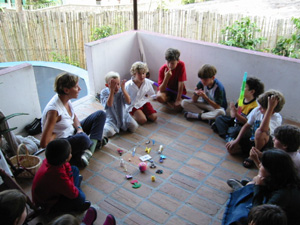
You only need a few things to have fun…
After absorbing the traumatic experience, I realized that if I wanted my children to have a full and interesting social life, I had to sacrifice my time and act on several directions:
– always being available to collect from school a thick group of screaming devils
…taking them home, and maybe even bringing them back to their homes or to a fixed place of town at the end of the afternoon (because both in Tegucigalpa and Lima we lived on the outskirts of town, far from the school, and from the neighborhood where most friends lived);
– introducing myself to the friends’ parents and bring them to trust me
…because the curiosity you stir up for being foreigner is not enough, you must also show them that you take good care of their children, you feed them when they are hungry, check the amount of TV they watch, etc.;
– making the stay of their children at our place as fun and involving as possible
so that they will always want to come back. We can’t expect our own children to accomplish this on their own; some of the tactics I used with great success in our nomad life include: preparation of memorable snacks, buying small gifts, provide children with all the necessary material to play in a creative way, let them free to use the house as a playing space, and not as a constrictive one;
– trying to relate to the parents
making friends amongst adults is the best way to provide our children with occasions to meet their friends, in an atmosphere of shared joy.
All of this worked wonders for us both in Honduras and, although with more difficulties at the beginning, in Peru. I have lost track of the number of kids/adolescents I have fed with pastas and pizzas, nor the mattresses I deflated in the morning and the bed sheets I took away. I do not know how many kilometers I drove with my car full (sometimes even illegally!) of creatures of every possible age, screaming excited at the idea of being pressed into a small space with the prospect of playing freely after a whole day at school. I cannot count the endless telephone calls I made to speak of all sorts of things with a plethora of parents.
One of the things I consider as most important when helping our children to make friends, it to participate as much as possible in their school life. A mother that acts as parents’ delegate in her children’s class will have a privileged channel to get in touch with the parents, will find out about things and situations that can indirectly stimulate her relationship with her children’s schoolmates and consequently have a positive influence on their friendships. She will gain the trust of the other parents and will find out more quickly what are the social conventions that regulate relations between young and adults.
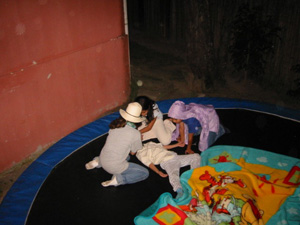
Playing on the trampoline in Tegucigalpa….
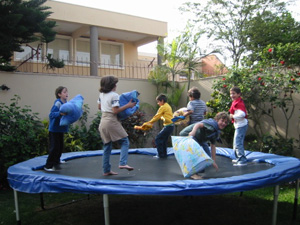
…and in Lima!
Changing the subject, I give you another piece of advice, which, I know, many parents will not appreciate. I tell you anyway: if you have a piece of garden, buy a big elastic trampoline. In our family the trampoline is strictly connected to our personal history abroad and to my children’s friendships.
We bought the first one in Honduras, when Mattia was 3 and Alessandro 8. They did everything on that trampoline: they jumped (obviously), ate, played, did their homework, talked, watched the stars, recited…for quite a while the trampoline became the emblem of fun at our house, a place of relaxation and of free and light relations.
How can we help them to say goodbye, to quit those persons that for months have filled their days, with whom they have grown, laughed, played, learnt and maybe even suffered a bit?
When we quit Honduras, for my children it has been almost as hard to leave their trampoline as to leave their friends. And this is why on their first Christmas in Peru, we offered them a new trampoline, of exactly the same dimensions of the one they had in Honduras. And even in the house in Lima, it has marked the rhythm of friendships and fun, starting with innocent jumping when they were still young upon arrival, to finish with big get-together with guitars and biers and the excited screaming of adolescent girls (that my neighbors in Lima know very well, they even made us get a fine for noises!) towards the end of our stay.
I know the trampoline can also be very dangerous, and indeed we always took a lot of time to explain again and again to everyone that they had to jump with a certain control and not doing unusual or dangerous things. In ten years of trampoline we had two accidents: Alessandro once broke his left wrist, and a friend of Mattia fractured the neck of the omerus. All in all the balance is still positive.
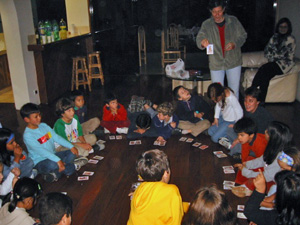 Always talking about family history in relation to friendships, I cannot avoid mentioning the legendary “Mercante in Fiera” (Merchant at the Fair), a card game that is usually played at Christmas in Italy, and that has conquered hoards of children in all continents, and turned our homes and parties into the most attended wherever we relocated.
Many Italians will probably know this very easy game, made up of two decks of identical cards, very practical to transport and not at all known abroad (at least in the abroad where I have been). Here you find the instructions to play, you can find the decks in any good toy place in Italy, or order them online.
Small children ADORE Mercante in Fiera at all latitudes. You just have to buy very small gifts (a chewing-gum, a rubber, some colors, a piece of chocolate) and to animate the game. It is a way to keep them quite (so to speak…) around a table or sitting on the floor for a couple of hours, while they have the greatest fun and you don’t have to run everywhere to control them.
Game after game, though, we get to the end of our stay in a country. What do we do in these cases? How can we help them to say goodbye, to quit those persons that for months have filled their days, with whom they have grown, laughed, played, learnt and maybe even suffered a bit?
When we left Honduras, I thought my heart would break in two seeing Alessandro suffering so much. Mattia was younger (we can’t deny that friendships weight differently according to the ages) and suffered less. Besides at that time Internet had not yet generated the big networks, Facebook did not exist, and families (at least ours!) shared one computer only, relationships still went through postcards!!!
In that phase we focused more on settling down in Lima rather than on the mourning of Honduras. On the contrary, when we left Peru, it was Mattia’s turn (12 and ½ years) to suffer the most. Mattia, unlike Alessandro, always had few but very good friends. While his brother moved amongt people of all kinds, ages and nationalities, Mattia stuck to a small group of friends whom he loved deeply, viscerally.
With these friends, in Peru, he had started a band, where he played the drums, called Dilema, that gave them moments of wonderful understanding, creativity and growth.
When we quit Peru, my sons were going through very different moments: Alessandro had finished high school and was preparing to go to France for university, Mattia felt perfectly at ease and happy in what he perceived as his true country, and went through the farewell suffering wildly. The incertitude on the next destination, the emotional confusion of having to settle in Italy without knowing for how long, his brother going to live away and the frequents travels of his father did not help the situation.
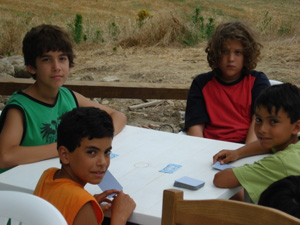
Mattia in Tuscany with three friends from Peru
Luckily when we quit Peru chat and Facebook had become realities in our lives, and this made a huge difference. For months my children kept on living on the Peruvian time zone, and at night they chatted with their friends, played online with them, exchanged messages on FB etc. This has certainly contributed to partly ease the pain of the goodbye.
Later Alessandro settled in France, in Lyon, and with great joy we learnt that many of his school friends of Lima had chosen France to continue their studies, and a big group was already in Lyon! This allowed Alessandro to start his new life with the support of friends who, even though going to other schools and universities, represented a strong reference point in that moment of total loss of contacts with familiar affective realities.
Other friends settled down in Paris, some in Montpellier, and other towns. They were thus able to frequently meet up in different points of the hexagon. In Lyon Alessandro even found old friends from Honduras!! During these two years spent in France, there were lots of moments of get together, fun, solidarity and love in the “Latin group”. This was a tremendous relief for us, and made us happily realize that despite having lived in five different countries in just seventeen years, Alessandro could count on solid friendships.
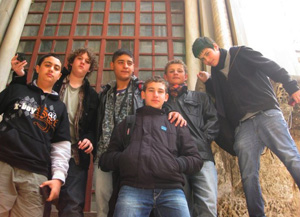
New friends for Mattia in Jerusalem
On the other hand Mattia has become amazingly mature after his forced stay in Milan, and arrived in Jerusalem in the best disposition. He also had the luck (you do need it sometimes!) to arrive in a very warm class, that welcomed him with affection and curiosity, and helped him find his place very rapidly.
After having spent little more than one year in Jerusalem, including holidays in Italy and a trip to Peru, Mattia has created a group of solid friends, and my house is again full of young that want to eat “pasta alla Claudia”, and keep us awake at night playing guitar (and even here I have to travel a lot by car because we live in yet another isolated spot!).
Mattia keeps contact with his friends in Peru, he went back to see them last year, and we have invited a couple of them in Italy this summer. They talk regularly on Messenger and Facebook, follow each others’ lives, and I that these links, even if they’ll fade with time, somehow will always constitute for them the backbone of the first emotional adventures outside of their family.
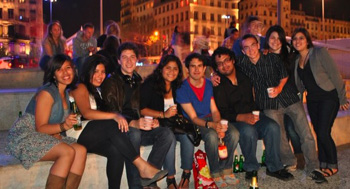
Alessandro with the “Latin gang” in Lyon
From time to time Alessandro tells me that the only reproach he has for this life we chose for him is not having childhood friends. We discussed this a lot and I believe I understand him, because it is indeed very nice for me to have friends that share my longtime memories of childhood and adolescence.
At the same time I try to convince him that real friendships, those that stay forever, are in most cases those born later on in life, when one is adult and aware of his choices. With his “Peruvian” friends (I call them so because we met them there, but many are French, or Belgian, or French Peruvian, etc.), the link is very strong, and some of them came to see us in Tuscany and even in Jerusalem. They are all boys who, like him, had a nomadic life, and who, like him, had to search their roots in other contexts, and share experiences spent in the remotest places of the world.

Alessandro in Palestine with two friends visiting from Peru
One last thing: as for every matter in life, the example we give our children is fundamental. For this reason I believe that it is important that we, as parents, do everything possible to keep our friendships alive, and show our children that it is possible to feel close to people even when being far away.
I have always done my best to stay in touch with the biggest number of friends, and my children participate in all the life events of these people – they know about births, change of countries, deaths, marriages and divorces of all of our friends. Our life is always full of long and short time friends, and of the various events that mark each other lives.
A bit by chance, but certainly not completely by chance, we created the tradition of a party in our house in Tuscany every three years. We organized one in 2005, one in 2008, and we host it this summer for the third time. It is a fantastic occasion during which we get together with a hundred friends that come from all over the world, with their sons and daughters. A rendez-vous that has become essential even for our children that invite their friends and enjoy the presence of the adults, who are also their friends.
Obviously not everyone has the chance to have a house in Tuscany that attracts people, that can combine a moment with us and a small holiday in one of the most beautiful regions of the world. However there are certainly many other ways – that can be ritualized – that can be invented in order to show our children that friendship is basic and that true friends, even if far away, are forever.
Claudia Landini (Claudiaexpat)
Jerusalem
May 2011
Articoli correlati:

Since you are here...
...may we ask you to buy us a ? We are joking of course, but there is something we would like to tell you.
You might have noticed that Expatclic has no ads or paywall. For 19 years we have been working voluntarily to provide quality contents and support to expat women all over the world. However, keeping such a big website going has some costs, which we partially cover with team member’s fees and donations of those who appreciate us and wants our work to continue. If you could give even a tiny contribution to cover the rest, we would be immensely grateful ♥
You can support us with a small donation, even a small one.
Thank you so very much.
? We are joking of course, but there is something we would like to tell you.
You might have noticed that Expatclic has no ads or paywall. For 19 years we have been working voluntarily to provide quality contents and support to expat women all over the world. However, keeping such a big website going has some costs, which we partially cover with team member’s fees and donations of those who appreciate us and wants our work to continue. If you could give even a tiny contribution to cover the rest, we would be immensely grateful ♥
You can support us with a small donation, even a small one.
Thank you so very much.


